
Why off-plan, and why not
Off-plan means buying a home that has not been built, from the developer, on a contract that fixes the price today and spreads the payments across the construction period. In Dubai it is the ordinary way new homes are sold, and it is governed by a specific set of laws that a UK buyer will not have met before. This guide walks through them in the order you will meet them.
The trade is simple to state. You get today's price, a payment plan instead of a lump sum, and a new building with a new specification. In exchange you take construction risk (the building may be late or may differ from the brochure), delivery risk (the developer may fail), market risk (the price may be lower on handover than when you reserved), and currency risk (you earn pounds and pay dirhams). There is no rent while it is being built, and there is no home to use.
Before any unit is put in front of you, three questions settle most of what follows.
- What is it for? Own use, letting, or both. A flat you will use needs a different location, size and finish from one you will let, and the two are taxed differently in the UK.
- When do you need it? Handover dates in Dubai are "anticipated". A two-year plan can become three. If you need a home by a date, buy something built.
- Where is the money coming from? Each instalment leaves a UK account, through a bank or a currency broker, at whatever rate applies that month. Chapter 06 is about this.
Off-plan suits a buyer who does not need the home yet, can fund every instalment without selling anything else, and would be content to hold the property through a weak year.
If that is not you, the right answer may be a completed property, or no property. An adviser who says so is doing the job.
Who is who, and how to check them
Dubai's property market is regulated by the Dubai Land Department (DLD) and its regulatory arm, the Real Estate Regulatory Agency (RERA). Everything below can be checked without taking anyone's word for it.
- The developer must be registered with RERA, must own the land (a title deed in a freehold or long-lease area; a preliminary sale certificate is not accepted) and must register the project before selling. The DLD's project-registration conditions currently require the developer to have completed 30% of construction, or to have lodged a bank guarantee or cash deposit for 30% of the project value, before off-plan sales. Earlier guidance said 20%, and some brokers still quote it; the DLD service page said 30% on 5 November 2026.
- The master developer owns and runs the wider community (the roads, the parks, the master community charge). Your service charge includes a contribution to it.
- The escrow agent is a bank approved by the DLD that holds the project account. Chapter 03.
- The broker must hold a RERA licence. A brokerage has an ORN (office registration number) and each adviser a BRN (broker registration number). Under the DLD's brokerage guide, a broker selling off-plan must confirm the project is registered with an escrow account and must tell you to pay only into that account.
- Langford Pierce advises from London. Its Dubai brokerage partner's name, ORN and each adviser's BRN will appear on every listing, with the Trakheesi permit number and QR code, the developer, the escrow account number and the anticipated completion date.
Ten minutes of checking
- Dubai REST. The DLD's app. For an off-plan project it shows the registered project, the live completion percentage, site photographs, the escrow account number and the payments due. It also shows broker offices and their performance ratings.
- Madmoun. Every property advertisement in Dubai must carry a QR code issued through the DLD's Trakheesi permit system (mandatory since 24 April 2023). Scanning it confirms the advert is genuine and RERA-approved, shows the authorised details, and whether the unit is already sold or let.
- The escrow account number. Ask for it. Compare it with Dubai REST. Any request to pay a reservation fee or instalment to a different account, a company account, or a broker's account is a reason to stop.
- The completion date in the SPA. The brochure date is marketing. The contract date, and the grace period after it, are what you can hold the developer to.
Escrow: what it protects and what it does not
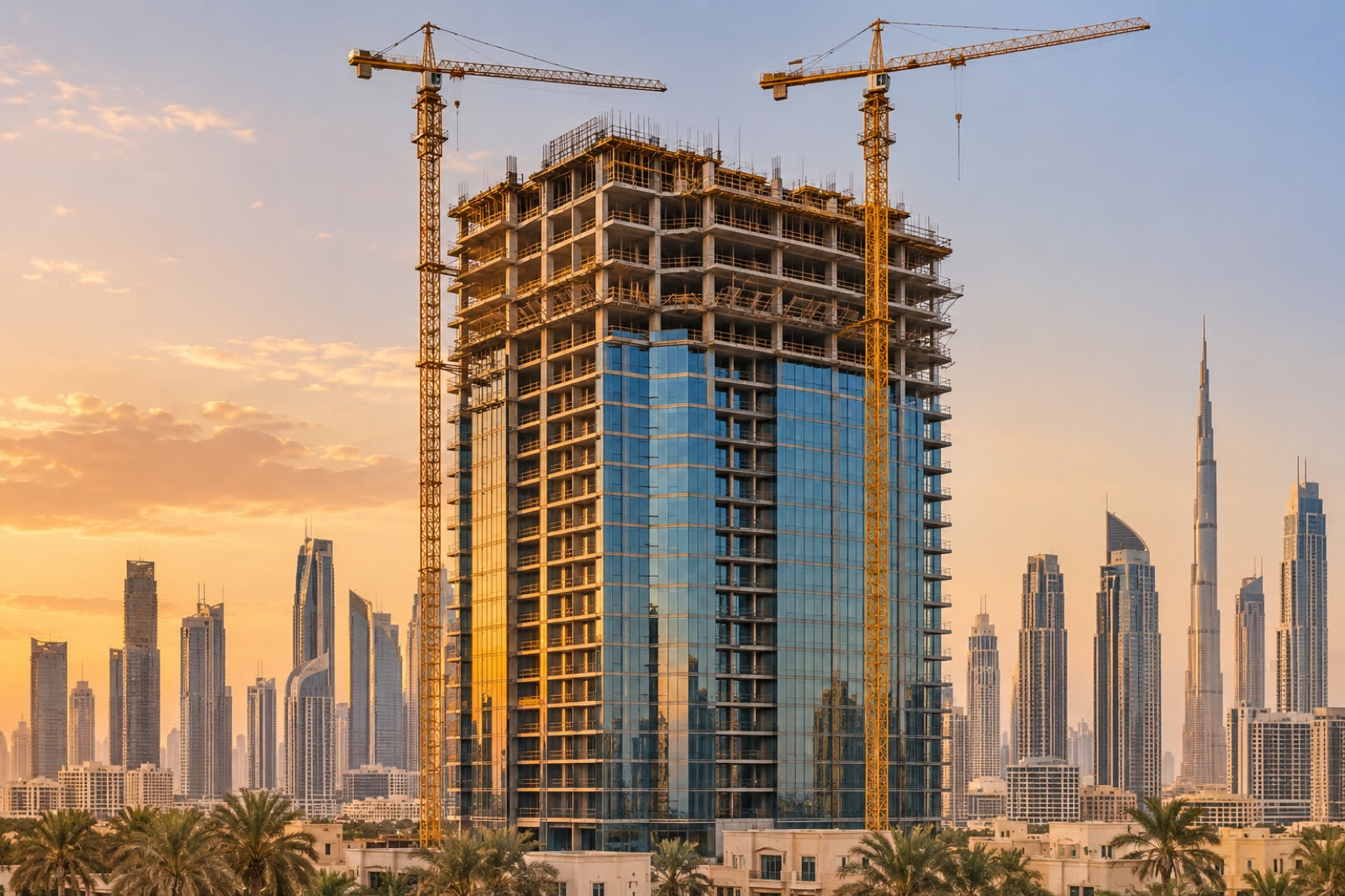
Dubai Law No. 8 of 2007 requires every off-plan project to have an escrow account with an approved bank. Your payments go into that account, which is dedicated exclusively to the construction of that project (Article 9). The developer draws on it as the building progresses, against certified construction stages, under the supervision of the DLD. After the completion certificate, the escrow agent keeps 5% of the account for a year from the date the units are registered to the buyers (Article 14), which is the fund that defects in the first year are meant to be paid from.
Since 2008 the sale itself is recorded on the DLD's interim register, the Oqood system (Law No. 13 of 2008). That registration is what makes you the recorded buyer of a specific unit in a specific project, rather than a name on a developer's spreadsheet.
What this protects
- Money paid for your project cannot be used to build a different project, to pay the developer's other debts, or to fund marketing.
- If the developer defaults, the DLD can step in, appoint another developer, or wind the project down with the funds still in the account.
- Your purchase is registered against the unit, not just against a contract.
What this does not protect
- Time. Escrow does not make a building arrive on the date in the brochure.
- Quality. It does not make the finish match the show flat. The SPA specification and the snagging inspection do that.
- Value. It does not stop the price of your unit, or of the hundred similar ones completing in the same month, from being lower at handover.
- Your money's path. It protects dirhams once they reach the project account. A reservation fee paid to anyone else is outside it.
- The exchange rate. Chapter 06.
Escrow answers one question, where the money sits, and answers it well. It does not answer whether you should buy.
The paper trail, from reservation to Oqood

Reservation. A unit is held with a reservation form and a fee, typically 10 to 20% of the price in current practice (some developers take 5 to 10%). There is no statutory cooling-off period in Dubai. If you do not sign the sale and purchase agreement within the window in the reservation form, commonly about five business days, the developer may cancel and keep the fee, although a court may reduce that. Reserve only when you have seen the floor plan, the payment plan and the total cost with fees, and only after the checks in Chapter 02.
The sale and purchase agreement (SPA). This is the contract. Read it, or have it read, before you sign. The clauses that matter most to a UK buyer:
- The anticipated completion date and the grace period the developer is allowed beyond it, often six to twelve months, during which no compensation is due.
- What happens after the grace period: whether any compensation is payable, how it is calculated, and whether you may cancel.
- Payment schedule tied to construction milestones or to calendar dates. A milestone plan slows down if the building does; a date plan does not.
- The area variation tolerance (what happens if the built unit is smaller or larger than the plan) and the specification schedule.
- The service charge estimate and whether the first year is payable in advance at handover.
- Assignment: whether, when and at what cost you may sell before handover (Chapter 11).
- The default clauses, which are set by law (Chapter 12), and any additional fees the developer adds.
- Governing law and dispute forum: Dubai courts, arbitration, or the DIFC courts.
Oqood registration. The developer registers the sale on the DLD's interim register, by law within 90 days of signing. The DLD fee is paid at this point: the DLD lists it as 2% of the sale value from the seller and 2% from the buyer, plus AED 10 knowledge and AED 10 innovation fees; by market convention the buyer pays the full 4%. You receive the Oqood certificate as proof of registration. Keep it with the SPA, the receipts and the escrow account details.
What you will be asked for. A passport copy, proof of your UK address, and, for larger purchases, evidence of the source of the funds (bank statements, a sale completion statement, payslips or company accounts). Dubai applies anti-money-laundering rules to property; the questions are normal and refusing them ends the purchase.
Payment plans, the 4% DLD fee and the total cost
A brochure price is the start of the arithmetic, not the end. Below is the full cost of a AED 2,000,000 apartment of 1,200 square feet on a 20/40/40 plan over about thirty-one months, at the rates and fees current on 5 November 2026. Replace every line with your own figures in the cost modeller that accompanies this guide.
| Item | Basis | AED | GBP at 4.95 |
|---|---|---|---|
| Brochure price | The SPA price | 2,000,000 | 404,040 |
| DLD registration fee | 4% of price, at Oqood registration | 80,000 | 16,162 |
| DLD knowledge and innovation fees | AED 10 each | 20 | 4 |
| Developer admin fee | Commonly AED 1,000 to 6,000 | 3,000 | 606 |
| Agent commission | Usually paid by the developer on off-plan | 0 | 0 |
| Utilities deposit (DEWA) | Refundable, at handover | 2,000 | 404 |
| Snagging survey | At handover | 2,500 | 505 |
| Total cost to own | Before furnishing, service charges and currency spread | 2,087,520 | 421,721 |
Three things change that figure in practice.
- The currency spread. A bank commonly takes 2 to 4% on a large transfer; a specialist broker under 1%. On this purchase the difference between 3% and 0.5% is about £10,500.
- Service charges. From handover, every year, whether the flat is let or empty. At AED 18 per square foot, AED 21,600 a year on this flat, rising with the building's budget. Chapter 10.
- A mortgage at handover. If you borrow 50% at handover, the cash at handover falls but arrangement, valuation and registration fees are added, and the monthly payment begins. Chapter 07.
Reading a payment plan
Plans are written as percentages: 20/40/40 means 20% at reservation, 40% during construction, 40% at handover. 60/40 and 70/30 are the usual shapes; post-handover plans (for example 50/50 with the second half over two years after handover) spread the final payments at a higher headline price. Ask three questions of any plan.
- Milestones or dates? A plan tied to construction stages is kinder if the building is late. A plan tied to dates keeps collecting.
- What is the cash position at handover? On a 20/40/40 plan, 40% of the price plus handover costs leaves your account in one month. Know the month, and know the rate risk on it.
- What has the post-handover plan cost you? Compare the price with the same developer's cash price. The difference is the cost of the credit.
The number that matters is the one that leaves your account, in pounds, on each date. The modeller exists to put that number in front of you before you reserve.
Money across borders
The dirham is pegged to the US dollar at 3.6725 and has been since 1997. Buying in Dubai is therefore a dollar exposure held by someone who earns pounds. On 5 November 2026 a pound bought about AED 4.95 at the mid-market rate; over 2026 it has moved between roughly 4.83 and 5.07. A 5% move in sterling changes the pound cost of a AED 2,000,000 flat by about £20,000, and it changes the sterling value of what you sell at the end by the same proportion.
Three habits that protect you
- Use a specialist currency broker, not the bank's standard rate. Brokers regulated by the FCA as payment institutions quote close to the mid rate for large sums. The saving is real money (Chapter 05) and the paperwork is the same.
- Know each instalment date and decide the rate in advance. A forward contract fixes the rate for a payment due in, say, nine months. It removes the risk of a worse rate and gives up the chance of a better one. That is a decision, not a product to be sold to you.
- Pay only into the project's escrow account, from an account in your own name, keeping every confirmation. The receiving IBAN on your transfer should match the escrow account number in Dubai REST.
Source of funds
Expect to show a passport, proof of address and evidence of where the money came from. For a sale of a UK property, the completion statement; for savings, statements covering the build-up; for a company, accounts and a dividend record. The DLD and brokers report large cash transactions, and no reputable party will take cash from you at all. A buyer who is asked nothing should be more worried, not less.
Mortgages for a non-resident
The UAE Central Bank's 2013 mortgage regulations set maximum loan-to-value ratios by buyer and property. For an expatriate resident's first home the cap is 80% below AED 5 million; for off-plan property the regulations cap lending at 50% of value, whoever the buyer is. Banks may lend less, and for buyers who live outside the UAE most do.
- Who lends to non-residents. A handful of banks, including HSBC, Emirates NBD, Mashreq and Standard Chartered, at 50 to 60% of value, usually at or near handover rather than during construction. A broker who deals with non-resident cases will know which bank is active this quarter.
- Cost. Fixed offers in late 2026 were commonly between 4% and 6.5%; variable loans price off EIBOR (about 4.2% for three months in October 2026) plus a margin. Expect an arrangement fee of about 1% of the loan, a valuation fee, mortgage registration at the DLD of 0.25% of the loan plus an admin charge, and compulsory life and property insurance.
- Conditions. A minimum income (commonly around AED 25,000 a month or the sterling equivalent), a maximum age at the end of the term, and a term of up to 25 years.
The practical plan for most UK buyers is therefore cash through construction and a mortgage, if wanted, at handover. Model the handover month both ways, and ask the bank for an indication in writing before you reserve rather than after.
A mortgage in dirhams on a flat let in dirhams is a hedge. A mortgage in dirhams paid from a salary in pounds is not.
The UK tax position for a UK resident

"Dubai has no tax" is true of Dubai. It is not true of you. A UK resident is taxed in the UK on worldwide income and gains, and a flat in Dubai is simply an overseas property on your self assessment. The figures below are from HMRC's Budget 2026 rates and allowances annex, updated 5 November 2026, and from the Budget 2026 announcements of 28 October 2026. They are general information, not advice; your own adviser applies them to your position.
In the UAE
- No personal income tax on rent, no capital gains tax on a sale by an individual, no annual property tax and no inheritance tax.
- VAT: the first sale of a new residential property within three years of completion is zero-rated; later residential sales and residential rent are exempt. Commercial property carries 5%.
- UAE corporate tax: income from property held personally, where no licence is required, is outside the scope for individuals (Cabinet Decision 49 of 2023).
In the UK: rent
- Rent is foreign property income, declared on the foreign pages of your self assessment. For 2026/27 it is taxed at the main income tax rates (20%, 40%, 45%).
- From 6 April 2027 property income is taxed at its own rates: 24%, 44% and 49% (announced at Budget 2026; to be legislated in the next Finance Bill).
- Service charges, management fees, repairs and insurance are deductible. Mortgage interest is not deducted; it gives a credit of 20% of the interest instead.
- The UAE charges no tax on the rent, so there is no foreign tax to credit and the UK tax applies in full. The UK-UAE double taxation agreement (in force since 25 December 2016) matters for other reasons, not this one.
In the UK: selling
- A gain on the sale is charged to capital gains tax at 18% (basic rate) or 24% (higher and additional rate) for residential property, with a £3,000 annual exempt amount. Overseas sales are reported on the self assessment for the year, not on the 60-day property form used for UK homes.
- HMRC computes the gain in sterling, converting the purchase at the rate of the purchase date and the sale at the rate of the sale date. A stronger dirham can therefore create a sterling gain on a flat whose dirham price has not moved. The cost modeller shows this.
- The 4% DLD fee, the Oqood admin fee, the agent's commission on sale and the transfer costs are part of the cost base.
In the UK: inheritance
- Since 6 April 2025 the UK inheritance tax net is based on residence. A long-term UK resident (resident in 10 of the previous 20 tax years) is within the net on worldwide assets, so a Dubai flat is counted. The nil-rate band is £325,000 and the rate 40%, both unchanged for 2026/27 and 2027/28.
- The UAE charges no inheritance tax, but it has its own succession rules. For a non-Muslim foreign owner, a will registered in the UAE (the DIFC Wills Service Centre, or the Dubai Courts' wills service for non-Muslims) is the clean way to make sure the flat passes as you intend; Federal Decree-Law 41 of 2022 also lets non-Muslims elect their home-country law. Register a will before handover. It costs a fraction of one month's service charge.
Two things UK buyers forget
- SDLT on your next English purchase. Owning a Dubai flat counts as owning another dwelling, so a later purchase in England or Northern Ireland while you still own it attracts the 5% additional-dwelling surcharge, unless you are replacing your main home.
- HMRC can see it. The UAE participates in the Common Reporting Standard, so UAE bank accounts in your name are reported to HMRC each year. Declare the rent from year one; the Worldwide Disclosure Facility exists for people who did not.
Buying through a company changes every line above, in both countries. It is sometimes right, usually for reasons unrelated to tax, and it is a matter for advice before you reserve, not after.
The Golden Visa, without the brochure gloss
The UAE's Golden Visa is a long-term, renewable residence visa, and property worth at least AED 2 million is one route to it. The route is run in Dubai by the DLD, which issues the nomination letter, with the visa itself from the federal immigration authorities. A few points that marketing material leaves out.
- AED 2 million of property value, which can be across more than one property. Joint owners other than spouses each need AED 2 million of their own share.
- Off-plan and mortgaged property have been accepted under DLD rules that have changed more than once, with conditions on registration, approved developers and bank letters. Confirm the conditions in force on the day you apply, not the day you reserved.
- The term. Dubai processes the real-estate category as a ten-year visa; the federal government portal's summary table (updated 28 July 2026) lists the real-estate investor category at five years. Ask which applies to your application and get it in writing.
- Family. A spouse and children can be sponsored. Government fees, medical and insurance come to a few thousand dirhams per person.
- What it is not. It is not citizenship, it does not require you to live in the UAE, and it does not by itself change your UK tax residence. That is decided by the UK's statutory residence test, by day counts and ties, not by a visa.
Buy the flat because the flat is right. Treat the visa as a consequence, confirmed at application, not a reason.
Living with it: handover, service charges, letting
Handover
- The developer gives notice of completion and the final instalment, service charge for the first period and any handover fees fall due.
- Commission an independent snagging inspection before you accept the keys. A written list, agreed with the developer, with dates for the fixes. The 5% escrow retention (Chapter 03) is the fund behind first-year defects; a defects liability period in the SPA is the contract behind them.
- Register the DEWA (utilities) account, pay the deposit, and the district cooling account where the building has one. Chilled water is a separate, metered bill in many towers and worth checking before you buy.
- Your title deed is issued by the DLD on completion, replacing the Oqood registration.
Service charges
Each building's annual budget is approved by RERA through its Mollak system and published on the DLD's service charge index, which you can check for any completed building in Dubai REST before you buy. Apartments were commonly in the range of AED 15 to 20 per square foot a year in 2026, with luxury towers higher, sometimes much higher. New buildings often start low and rise as the real running costs appear. Budget for the charge whether the flat is let, used or empty, and expect it to increase.
Letting
- Long lets are registered with the DLD's Ejari system, usually for a year, with rent commonly paid in one to four cheques in advance. A management company typically charges around 5% of the rent to find and manage a tenant.
- Short lets require a holiday-home permit from Dubai's Department of Economy and Tourism, a licensed operator or your own licence, furnishing, and management fees that are a multiple of long-let fees. Income is lumpier and more seasonal.
- Voids. Allow for them, especially in a building that has just completed, when every owner is looking for a tenant at once (Chapter 11).
We do not forecast rents in this guide, and we would be wary of anyone who does. Take asking rents from comparable listings in the building or area today, apply the costs above, test the result at a lower rent, and ask whether you would still be content.
Exit: resale rules and the handover wave
Selling before handover
An off-plan contract can usually be assigned to a new buyer before completion, but only with the developer's no-objection certificate. Developers typically require that 30 to 40% of the price has been paid before they will issue one, and they charge for it: commonly AED 1,000 to 5,250 plus VAT, with some charging more. The new buyer pays the 4% DLD fee again on the resale, and if the transfer goes through a registration trustee the trustee fee of AED 4,000 plus VAT (AED 2,000 below AED 500,000) applies. Agent commission on a resale is customarily 2%. Check the SPA's assignment clause before you reserve; some developers restrict assignment until a higher percentage is paid, or until handover.
Selling after handover
A completed property is sold through a registration trustee office: the buyer pays the 4% DLD fee and the trustee fee by convention, the seller pays the agent, any mortgage is settled from the proceeds, and the title deed transfers the same day. From a UK point of view the tax events are in Chapter 08.
The handover wave
Off-plan projects complete in waves. When a tower of three hundred units hands over, a large share of them reach the letting market and the resale market within the same few months, from owners who bought on similar plans and have the same final instalment to fund. For a buyer who intended to sell at handover, that is the worst month to do it. For a buyer who intended to let, it is the month with the most competing landlords.
Plan to hold through the handover wave. If your plan only works by selling at completion, it is not a plan, it is a bet on a crowded exit.
The practical consequences: look at how many units in the same community complete in the same year, do not model rent from the first month, and keep a cash reserve for the service charge and a void.
If something goes wrong
If the developer is late
Read the completion clause: the anticipated date, the grace period, what is payable after it and whether you may cancel. Dubai REST shows the project's certified completion percentage; if it has stopped moving, ask the DLD. RERA can cancel a stalled project and refund buyers from the escrow account, through a process that is slow and not in your control.
If you cannot pay
Law No. 19 of 2017, which amended the 2008 interim register law, sets the procedure and the developer's rights when a buyer defaults on an off-plan contract.
- The developer notifies the DLD, which serves you a 30-day notice and will try to mediate.
- If the notice expires without a settlement, the DLD certifies the project's completion percentage, and the developer's remedies depend on it:
| Construction completed | The developer may |
|---|---|
| More than 80% | Hold you to the contract and claim the balance; ask the DLD to auction the unit to recover it; or terminate and keep up to 40% of the price |
| 60% to 80% | Terminate and keep up to 40% of the price |
| Less than 60%, work started | Terminate and keep up to 25% of the price |
| Work not started, for reasons beyond the developer's control | Terminate and keep up to 30% of what you have paid, refunding the rest within 60 days |
Where the developer keeps 40% or 25% of the price, the balance of what you paid is refundable within a year, or within 60 days of the unit being resold, whichever is earlier. You keep the right to go to court or to arbitration. The lesson is upstream of the law: do not reserve a unit whose instalments depend on money you do not yet have.
If the broker is the problem
Complaints about a licensed broker go to RERA through the DLD. Keep the Trakheesi permit number of the advert and the broker's BRN. A broker who asked you to pay anywhere other than the escrow account has breached the DLD's rules, and that is the first thing to report.
Twenty questions, in the order an adviser would ask them
- What is this property for, and does the location, size and finish match that use?
- Can every instalment be paid from money you already have, without selling anything?
- Could you hold it through a weak year at handover without selling?
- Is the developer registered with RERA, and does it hold the title to the land?
- Is the project registered, and what completion percentage does Dubai REST show today?
- What is the escrow account number, and is it the only account you will ever be asked to pay?
- Does the advert carry a Trakheesi permit number and a Madmoun QR code that match the listing?
- What is the completion date in the SPA, and how long is the grace period after it?
- What happens after the grace period: compensation, cancellation, or nothing?
- Is the payment plan tied to construction milestones or to calendar dates?
- What is the total cost with the 4% DLD fee, admin fees, handover costs and the currency spread, in pounds, per date?
- What is the cash position at handover, with and without a mortgage, and which bank has said in writing it would lend?
- What is the service charge estimate, and what do comparable completed buildings nearby pay on the DLD index?
- Is the first year's service charge payable at handover?
- What is the area variation tolerance and the specification, and are they in the contract?
- When may you assign the contract, what percentage must be paid first, and what is the NOC fee?
- How many units in this community complete in the same year?
- How will this be taxed in the UK on rent, on sale and on death, and have you had advice on it?
- Have you decided how each instalment will be converted, and by whom?
- If the Golden Visa matters to you, which conditions apply on the day you apply, in writing?
Sources and dates
Every figure in this guide, where it came from
- Dubai Land Department, "Request to register the initial sale" (Oqood) e-service page: 2% seller, 2% purchaser, AED 10 knowledge fee, AED 10 innovation fee, AED 1,000 developer self-registration, registration within 90 days. Read 5 November 2026.
- Dubai Land Department, "Register project" e-service page: freehold or long-lease land with an ownership deed, developer registered in Trakheesi, and a 30% cash deposit, bank guarantee or completed construction before sales. Read 5 November 2026. The DLD's "Know Your Rights" guide (Al Tamimi, 2017) described the earlier 20% rule.
- Law No. 8 of 2007 Concerning Escrow Accounts for Real Estate Development in the Emirate of Dubai, Articles 9 and 14. Dubai Legislation Portal (dlp.dubai.gov.ae).
- Law No. 19 of 2017 Amending Law No. 13 of 2008 Regulating the Interim Real Property Register in the Emirate of Dubai, Article 11. Dubai Legislation Portal.
- Dubai Land Department, Dubai REST e-service page (completion percentage, site photos, escrow account number, payments due) and Madmoun announcement of 18 April 2023 (QR codes mandatory on adverts from 24 April 2023). DLD brokerage guide, November 2024 (brokers must confirm escrow registration and direct payments to the escrow account).
- Charles Russell Speechlys, "How binding is an off-the-plan reservation agreement in the UAE", 22 June 2026: reservation deposits typically 10 to 20%, SPA signing within about five business days.
- Dealr, "Dubai off-plan fees: DLD and Oqood", updated 12 July 2026: developer admin fees AED 1,000 to 6,000; NOC fees AED 1,000 to 5,250 plus VAT; buyer pays the full 4% by convention. A secondary source.
- Engel & Völkers Dubai, "Trustee fee", 8 January 2026 (AED 2,000 plus VAT below AED 500,000, AED 4,000 plus VAT above) and "RERA service charge index", updated 7 September 2026 (apartments commonly AED 15 to 20 per square foot a year; luxury towers AED 20 to 50). Secondary sources.
- UAE Central Bank, Regulations Regarding Mortgage Loans (2013), as reported by The National on the cap's introduction: off-plan lending capped at 50% of value. Non-resident lending practice, rates and fees: UAE mortgage broker guides, June 2026 (a secondary source; indicative only). EIBOR three-month fixing about 4.21% on 19 October 2026 (Central Bank of the UAE data).
- UAE Government portal (u.ae), "Golden visa", updated 28 July 2026: investors in real estate, minimum AED 2 million; the portal's table lists the real-estate category at five years. Dubai Land Department and service-centre guidance describe a ten-year permit. Confirm at application.
- UAE Federal Tax Authority FAQs (personal capital gains outside corporate tax) and Cabinet Decision No. 49 of 2023 (real estate investment income of natural persons outside the scope of corporate tax), as summarised by PwC Middle East; FTA guidance on residential VAT (first supply within three years zero-rated, later supplies exempt).
- HM Revenue & Customs, "Annex A: rates and allowances", Budget 2026 overview of tax legislation and rates, first published 28 October 2026, updated 5 November 2026: property income at the main rates for 2026/27 and at 24%, 44% and 49% from 2027/28; capital gains annual exempt amount £3,000; inheritance tax nil-rate band £325,000 and 40% rate; SDLT additional-dwelling rates. HMRC policy paper "Income Tax: changes to tax rates for property and savings income", 29 October 2026.
- GOV.UK, "Capital Gains Tax: rates" (18% and 24% on residential property) and "Tax on foreign income: rent and other income from abroad". HMRC guidance on the 5% higher rates for additional dwellings (property anywhere in the world counts), in force since 31 October 2024.
- GOV.UK, "2016 UK-UAE Double Taxation Convention", in force 25 December 2016, effective from 1 January 2017.
- Exchange rates: GBP to AED mid-market about 4.95 on 5 November 2026 (open exchange-rate feeds, cross-checked against the 3.6725 dollar peg and a GBP/USD rate of about 1.347); 2026 range about 4.83 to 5.07 (Pound Sterling Live). Transfer spreads: currency broker published comparisons, 2026 (indicative).
Where a figure comes from a secondary source it is marked as such above and should be confirmed with the developer, the bank or the authority before you rely on it. Rules in both countries change; the edition date on the cover is the date to which this guide was checked.